WW2 Bunker
Veritas: ARSOF in the Korean War: Part I
Veritas: ARSOF in the Korean War: Part I
Author: U.S. Army Special Operations Command History Office
Condition: Good
Couldn't load pickup availability
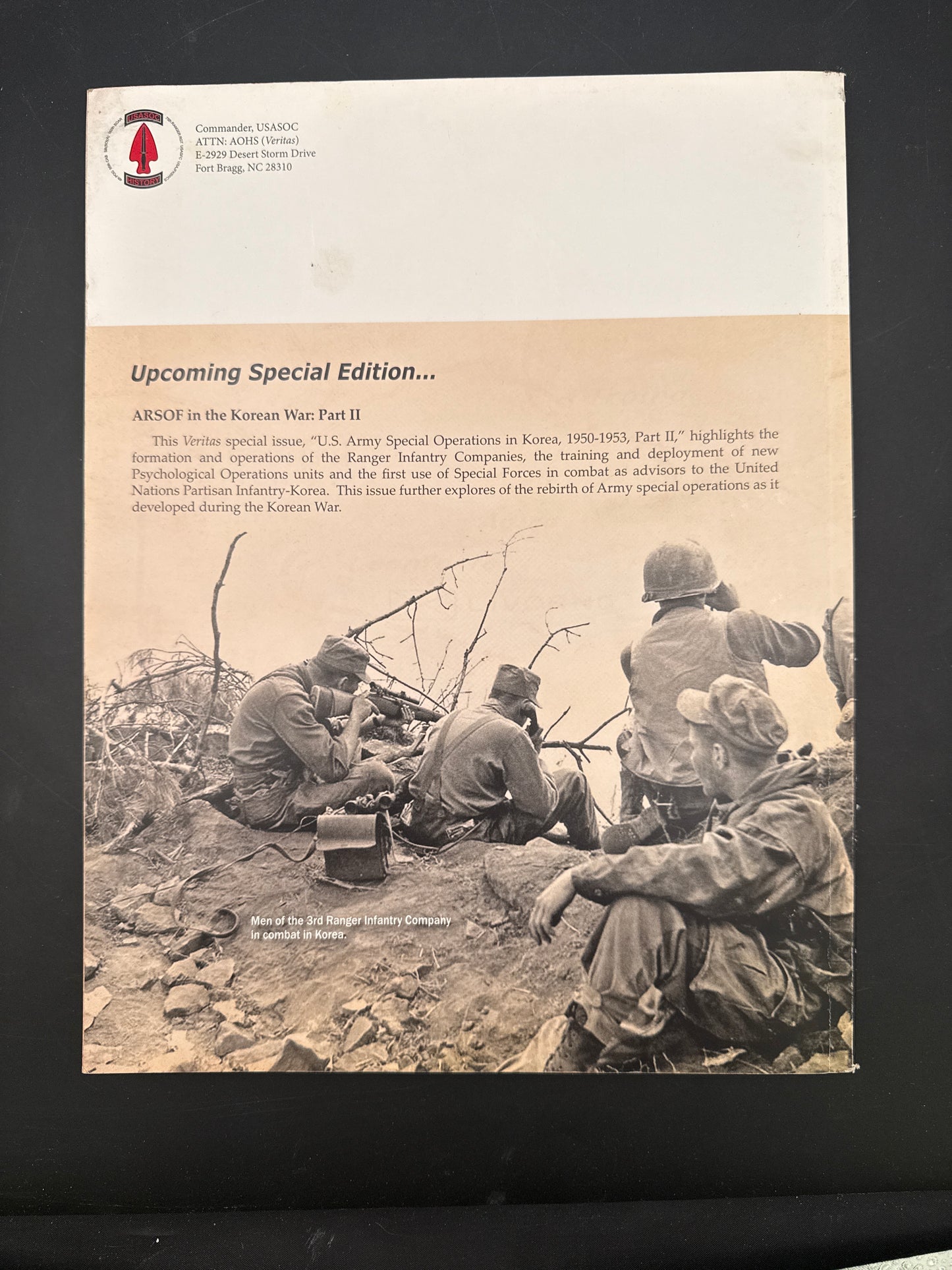
Veritas: ARSOF in the Korean War: Part I chronicles the birth and battlefield baptism of U.S. Army Special Operations Forces during the opening phase of the 1950–53 Korean War, using declassified documents, official records, and firsthand accounts to trace how Rangers, GHQ Raiders, psywar teams, civil‑affairs detachments, and guerrilla commands were rapidly organized and adapted to a volatile theater. The narrative combines detailed mission accounts and personal stories to illuminate ARSOF’s roles in intelligence, guerrilla warfare, evacuation and evasion, psychological operations, and early doctrinal development—showing how these actions and improvisations shaped the identity and institutional foundations of modern U.S. Army special operations.
Produced by the U.S. Army Special Operations Command History Office and issued as Part I of the Veritas journal, the volume draws on official access to records and veterans’ testimony and is richly illustrated with historical photographs, maps and phase overviews, timeline graphics for civil affairs and psywar activities, icon biographies, examples of wartime leaflets, and references to period Signal Corps films; its mix of archival evidence and visual materials makes it a valuable, grounded resource for scholars and enthusiasts of special‑operations and Korean War history.
Share
Keywords, content and topics in this Book
Keywords, content and topics in this Book
Title / Series
Veritas: ARSOF in the Korean War: Part I
Veritas – Journal of Army Special Operations History
Army Special Operations Forces (ARSOF) in the Korean War
Type of Book
Campaign history
Unit and formation history (ARSOF)
Military history journal (special operations focus)
Official / semi‑official U.S. Army Special Operations Command history
War and Theater
Korean War (1950–1953)
Korean Peninsula
Far East theater
Republic of Korea (South Korea)
North Korea
Off‑shore islands (guerrilla‑held islands off Korea)
Phases / Campaigns Covered (Part I emphasis)
Phase I – United Nations Defensive, 27 June – 15 September 1950
“War in the Land of the Morning Calm” – early Korean War overview
Early Special Operations in the Korean War
Early UN efforts to stabilize the front
Order of battle of UN and Chinese Communist forces (context for later phases)
Main Nations & Forces Involved
United States Army
U.S. Army Special Operations Forces (ARSOF)
Republic of Korea (ROK) armed forces
United Nations Command forces
North Korean People’s Army (NKPA)
Chinese Communist Forces (CCF)
Branches, Units, and Organizations
U.S. Army Special Operations Forces (ARSOF)
Ranger units and raider units
GHQ Raiders
Eighth Army Rangers
Ranger Infantry Companies in Korea
Psychological warfare (psywar) units
1st Loudspeaker and Leaflet (L&L) Company
1st Radio Broadcasting & Leaflet (RB&L) Group
Civil Affairs units
North Korean anti‑communist guerrillas (off‑shore islands)
Army guerrilla commands and advisory efforts
Operational and Thematic Focus
Special operations in the Korean War
Rebirth and development of U.S. Army Rangers in Korea
Raiders and Ranger training programs
Early ARSOF doctrine and practice
Guerrilla warfare and anti‑communist resistance in Korea
Off‑shore island guerrilla operations and advisory missions
Psychological warfare operations in Korea
Civil Affairs operations and military government functions
UN civil assistance and refugee support (e.g., Chinnamp’o, Hungnam context)
Creation of the Psywar Center at Fort Bragg, North Carolina
Origins of the U.S. Army John F. Kennedy Special Warfare Center and School
Transformation of ARSOF between 1950 and 1953
Specific Topics / Articles Associated with Part I Issue
“War in the Land of the Morning Calm” – Korean War overview
“Born of Desperation” – early special operations in the Korean War
“The Price of Stabilization” – cultivating and perpetuating knowledge
“25 July 1950 – Three Combat Forces” – early war combat narrative
“Eighth Army Rangers – First in Korea”
“GHQ Raiders – Wonsan to Chang‑to”
CA/PSYWAR Timeline, 1950–1953 (Civil Affairs and Psywar chronology)
“From a Standing Start – U.S. Army Psychological Warfare and Civil Affairs in the Korean War”
“The ‘Proper Ganders’ – 1st Radio Broadcasting & Leaflet Group” (background and Korea operations)
“A Civil Affairs Pioneer – BG Crawford F. Sams, U.S. Army Medical Corps”
“Same Organization, Four Different Names – U.S. Army Civil Affairs in Korea 1950–1953”
“Do What You Can – UN Civil Assistance, Chinnamp’o, North Korea”
“Giant Enters the Battle – Order of Battle of the UN and Chinese Communist Forces”
“Volunteering for Combat – Loudspeaker Psywar in Korea”
Named Individuals and Leaders
BG John H. McGee – soldier, leader, trainer
Republic of Korea General Paik Sun‑yup – ROK’s most decorated Korean War veteran
BG Crawford F. Sams – U.S. Army Medical Corps, Civil Affairs pioneer
Operations, Activities, and Themes (Verifiable)
Early defensive operations of UN forces in Korea
Reconstitution and deployment of Ranger companies in Korea
GHQ Raider actions (e.g., Wonsan to Chang‑to)
UN occupation and administration of North Korean areas (e.g., P’yongyang – context from the series)
Aircrew recovery and escape & evasion operations (Eastern and Western Korea)
Civil Affairs support to Korean civilians and occupied areas
Development and execution of psywar leaflet and loudspeaker campaigns
Use of radio broadcasting in psychological warfare (Radio Pusan and related efforts across the series)
UN refugee evacuation and humanitarian assistance (e.g., Hungnam – covered in the overall ARSOF Korea project)
Order‑of‑battle analysis of UN and Chinese Communist forces
Institutionalization of psywar and SF training at Fort Bragg
Visual and Media Content
Historical photographs (ARSOF units, Rangers, guerrillas, leaders)
Maps and phase overviews (five phases of the Korean War)
Photographic overviews of guerrilla commands and ARSOF activities
Images of psywar leaflets from the Korean War
Timeline graphics for CA and PSYWAR activities
Icon biographies with portrait images of key ARSOF figures
References to period U.S. Army Signal Corps videos (First Forty Days in Korea, Turning of the Tide, etc.)
Classification / Tags (for Cataloging)
Korean War – special operations
Korean War – United States Army
Korean War – Rangers
Korean War – guerrilla warfare
Korean War – psychological warfare
Korean War – civil affairs
U.S. Army – Special Operations Forces history
U.S. Army – Ranger units – history
U.S. Army – psychological operations – history
U.S. Army – civil affairs – history
Guerrilla operations – Korea, 1950–1953
Military campaigns – Korea, UN Defensive phase
Military advisors – Korea
Refugees and civil assistance – Korean War (as covered in ARSOF operations)
Fort Bragg – Psywar Center – origins
John F. Kennedy Special Warfare Center and School – antecedents
United States Army Special Operations Command publications
Military history periodicals – 21st century
Book Condition: Good
Book Condition: Good
You’ve reached the divisional archives. Whether you are looking for the technical blueprints of a Panzer, the gritty memoirs of an infantryman, or a bird’s-eye view of the Pacific Theater, we’ve got your intel right here. Our collection ranges from technical specs and biographies to rare photo journals and historical novels.
Before you enlist a new title into your personal library, check the Condition Report below to see how much action these volumes have seen:
New: Fresh Out of Bootcamp
Flawless and untested. This book is in pristine, new condition and ready for its first assignment.
Like New: Light Combat Experience
Almost new and in great shape. It has clearly been read before and is ready to fight again, but it shows very little wear from its time in the field.
Good: A Few Scars or Shell Shock
A reliable veteran. The book might have some bent corners or a dust cover with a few scratches, but it’s still sturdy and standing tall.
Fair: Battle-Hardened
Visible signs of a long campaign. Expect some stains, bent pages, and perhaps some minor tears on the cover. It’s seen the trenches, but the intel inside is still solid.
Poor: Survived Iwo Jima
This one has been through the meat grinder. It carries noticeable damage, heavy staining, or significant wear—but like any old soldier, it would love to be read one last time before it retires.