WW2 Bunker
The Crucial Decade—and After: America, 1945–1960
The Crucial Decade—and After: America, 1945–1960
Author: Eric F. Goldman
Condition: Like New
Couldn't load pickup availability
The Crucial Decade—and After: America, 1945–1960 by Eric F. Goldman offers a vivid exploration of the transformative years following World War II, a period that shaped the modern American landscape. Goldman delves into the political, social, and cultural shifts that defined the era, from the rise of the Cold War and the Red Scare to the beginnings of the Civil Rights Movement and the emergence of suburbia. Through engaging narrative and insightful analysis, he reveals how the nation grappled with newfound global responsibilities, internal anxieties, and the challenges of prosperity.
Goldman brings to life the key figures and events that influenced the direction of the United States during these pivotal years. He examines the presidencies of Truman and Eisenhower, the impact of McCarthyism, and the cultural undercurrents that would later erupt in the 1960s. The book’s accessible style and rich detail make it an essential read for anyone interested in understanding how the foundations of contemporary America were laid during this crucial decade and its immediate aftermath.
Share
Keywords, content and topics in this Book
Keywords, content and topics in this Book
Core bibliographic information
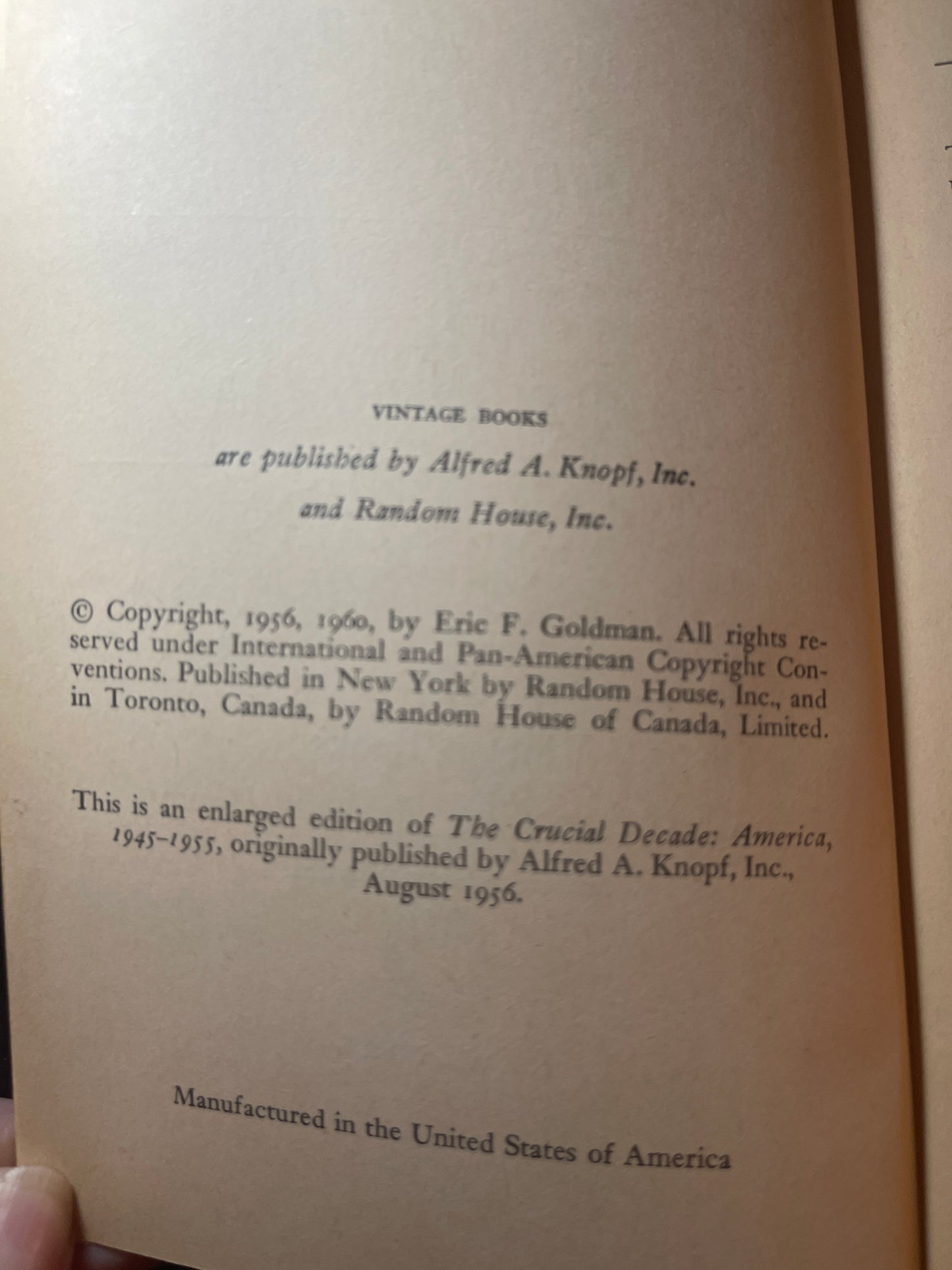
Title: The Crucial Decade—and After: America, 1945–1960
Author: Eric F. Goldman
Publication date: 1960 (Vintage paperback edition 1961)
Genre: Historical non-fiction; U.S. political and social history
Period covered: 1945–1960 (early Cold War era, post–World War II United States)
Geographical focus: United States of America (domestic politics, society, culture)
Type of book
General interpretive history (synthesis), not a memoir or unit history
Focus on U.S. domestic politics, ideas, and culture in the early Cold War
Secondary source (written by a professional historian)
Chronological and thematic scope
Immediate post–World War II period (1945–1949)
Korean War era and early 1950s politics
Late 1950s and transition toward the 1960s
Truman presidency
Eisenhower presidency
Origins of the Cold War (U.S. perspective)
Containment policy (U.S. interpretation, domestic dimension)
McCarthyism and anti‑communism in the U.S.
Domestic impact of the Cold War on American politics and society
Economic growth and consumer culture in postwar America
Intellectual life and political ideas in the 1945–1960 period
Relation to World War II and military history
Post–World War II American history (aftermath and legacy of WW2)
Transition from wartime to peacetime in the United States
American home front in the immediate postwar decade
Demobilization and return of veterans (contextual, not unit‑level)
Beginning of the nuclear age and Cold War tensions (U.S. domestic angle)
Theater(s) of war / operations
Focus is not on World War II theaters or specific campaigns
World War II appears primarily as background and antecedent to the post‑1945 period
Covers the American home front and domestic politics after WW2
Korean War is treated in terms of its political and social impact on the U.S., not as a campaign history
Main nation(s) involved
United States of America (primary focus)
Union of Soviet Socialist Republics (USSR) – chiefly as the principal external adversary in Cold War context, seen from U.S. perspective
Broader “Free World” versus communist bloc appears in diplomatic and ideological context
Military units, branches, weapons, and vehicles
No sustained focus on specific military units or formations
No sustained focus on particular weapons systems, ships, aircraft, or vehicles
Military matters appear mainly in relation to policy (e.g., defense spending, nuclear arms, Cold War strategy) rather than technical or operational detail
Famous leaders and historical figures featured
Harry S. Truman
Dwight D. Eisenhower
Joseph McCarthy
Key figures in U.S. politics and public life of the 1945–1960 period (cabinet members, party leaders, public intellectuals; discussed as part of U.S. political narrative)
Visual content
Standard narrative history; available descriptions do not indicate that extensive photographs, maps, blueprints, or technical diagrams are a central feature of the book
Subject and content keywords (cataloging and search)
United States — History — 1945–1953
United States — History — 1953–1961
Post–World War II America
Cold War — United States — Domestic aspects
U.S. domestic politics, 1945–1960
Truman era politics
Eisenhower era politics
McCarthyism and anti‑communism
Containment policy — U.S. interpretation
American liberalism and conservatism, mid‑20th century
American society and culture, 1945–1960
Economic growth and consumer society, postwar U.S.
Intellectual history of mid‑century America
Political climate of the 1950s
Early nuclear age (U.S. political and social response)
Classification suggestions
Library of Congress–style subjects
United States — History — 1945–1953
United States — History — 1953–1961
United States — Politics and government — 1945–1953
United States — Politics and government — 1953–1961
Cold War — Social aspects — United States
Cold War — Political aspects — United States
General / shelving classification hints
U.S. History – Post‑1945
Cold War – U.S. domestic history
American political history – Truman & Eisenhower administrations
Mid‑20th‑century American society and culture
Book Condition: Like New
Book Condition: Like New
You’ve reached the divisional archives. Whether you are looking for the technical blueprints of a Panzer, the gritty memoirs of an infantryman, or a bird’s-eye view of the Pacific Theater, we’ve got your intel right here. Our collection ranges from technical specs and biographies to rare photo journals and historical novels.
Before you enlist a new title into your personal library, check the Condition Report below to see how much action these volumes have seen:
New: Fresh Out of Bootcamp
Flawless and untested. This book is in pristine, new condition and ready for its first assignment.
Like New: Light Combat Experience
Almost new and in great shape. It has clearly been read before and is ready to fight again, but it shows very little wear from its time in the field.
Good: A Few Scars or Shell Shock
A reliable veteran. The book might have some bent corners or a dust cover with a few scratches, but it’s still sturdy and standing tall.
Fair: Battle-Hardened
Visible signs of a long campaign. Expect some stains, bent pages, and perhaps some minor tears on the cover. It’s seen the trenches, but the intel inside is still solid.
Poor: Survived Iwo Jima
This one has been through the meat grinder. It carries noticeable damage, heavy staining, or significant wear—but like any old soldier, it would love to be read one last time before it retires.