WW2 Bunker
Hitler's Gift The True Story of the Scientists Expelled by the Nazi Regime
Hitler's Gift The True Story of the Scientists Expelled by the Nazi Regime
Author: J. S. Medawar and David Pyke
Condition: Like New
Couldn't load pickup availability
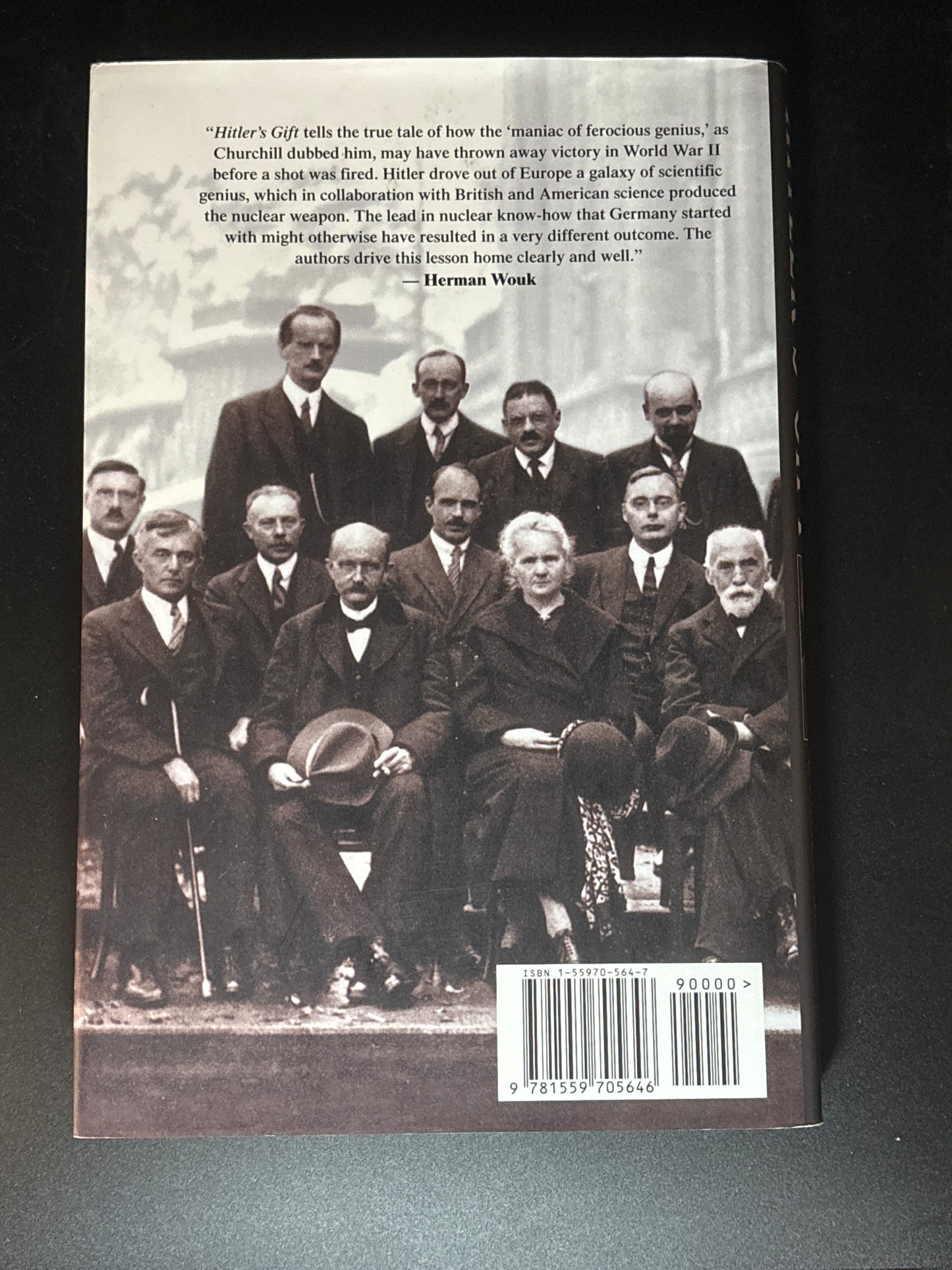
Hitler's Gift: The True Story of the Scientists Expelled by the Nazi Regime tells the story of the more than 1,500 Austrian and German scientists who fled—or faced the choice to stay—during the 1930s–40s as the Third Reich consolidated power. Through portraits of émigrés such as Albert Einstein, Fritz Haber and Leo Szilard and of those who remained like Max Planck, Werner Heisenberg and Max von Laue, the book situates personal biographies within the wider historical forces of antisemitic legislation, academic purges and the resulting brain drain that reshaped European science and contributed to scientific advances in Britain and the United States.
This is a non‑fiction, text‑focused historical study and collective biographical account by J. S. (Jean) Medawar and David Pyke, published by Arcade Publishing (ISBN13: 9781559705646). It emphasizes intellectual and wartime history—science under dictatorship, exile and the diaspora of scientists—and, based on available descriptions, does not clearly document extensive maps or photographic material; its value lies primarily in narrative analysis and archival storytelling for readers interested in the intersection of science, politics and exile.
Share
Keywords, content and topics in this Book
Keywords, content and topics in this Book
Core bibliographic data
Title: Hitler's Gift: The True Story of the Scientists Expelled by the Nazi Regime
Authors: J. S. (Jean) Medawar; David Pyke
Publisher: Arcade Publishing
Type and scope of book
Non-fiction
Historical study
History of science
Intellectual history
Biographical collective study (multiple scientists)
World War II era context
Main themes and focus
Loss of scientific talent from the Third Reich
Relation between dictatorship, antisemitism, and scientific decline
World War II classification
World War II – home front and civilian experience
World War II – scientific and intellectual aspects
Persecution of Jews and opponents under the Nazi regime (professional and academic)
Pre‑war and wartime Europe (1930s–1940s)
Theaters, nations, and geography
Axis power: Nazi Germany
Allied powers: Britain; United States
Key locations: German universities and research institutes; Austrian institutions; British and American universities and laboratories (receiving émigrés)
Theater classification: European context; home front / academic and scientific milieu (rather than combat operations)
People and scientific fields
Refugee physicists
Refugee chemists
Nobel Prize–winning scientists (context of losses and émigré achievements)
Subject and topical keywords
Persecution of scientists
Academic purges in Nazi Germany
Dismissal of Jewish professors
Exile and diaspora of scientists
Refugee intellectuals
Brain drain from Germany and Austria
History of German science, 20th century
History of Austrian science, 20th century
Science and politics
Science under dictatorship
Antisemitic legislation and professional exclusion
Universities under the Third Reich
Emigration to Britain
Emigration to the United States
Contribution of émigré scientists to Allied science and technology
WW2‑related classification (library / catalog style)
World War, 1939–1945 – Science and technology – Social and political aspects
World War, 1939–1945 – Refugees – Scientists
Jews – Germany – Intellectual life – 20th century
Scientists – Germany – Biography (collective)
Exiles – Germany – History – 20th century
National socialism and intellectual life
Germany – Emigration and immigration – 20th century
Weapons, operations, and campaigns
No specific military operations or campaigns (e.g., Operation Overlord, Barbarossa) are identified as central topics in available descriptions.
No specific weapons systems or vehicles are clearly indicated as a major, sustained focus of this book in available sources.
Format and visual material
Text‑focused historical narrative; available descriptions do not clearly document extensive visual content (such as numerous photos, maps, technical diagrams), so this cannot be confirmed from current sources.
Tag list (condensed for search/catalog)
World War II – science and scientists
Nazi regime – academic purges
Expelled scientists – Germany and Austria
Refugee scientists – Britain
Refugee scientists – United States
Jewish scientists – persecution
National Socialism and science policy
Brain drain – Third Reich
Albert Einstein – exile
Fritz Haber – exile
Leo Szilard – exile
History of physics – 20th century (émigré context)
History of chemistry – 20th century (émigré context)
History of medicine and biology – 20th century (émigré context)
Intellectual refugees – Europe 1930s–1940s
Universities under Nazism
Third Reich – loss of talent
Book Condition: Like New
Book Condition: Like New
You’ve reached the divisional archives. Whether you are looking for the technical blueprints of a Panzer, the gritty memoirs of an infantryman, or a bird’s-eye view of the Pacific Theater, we’ve got your intel right here. Our collection ranges from technical specs and biographies to rare photo journals and historical novels.
Before you enlist a new title into your personal library, check the Condition Report below to see how much action these volumes have seen:
New: Fresh Out of Bootcamp
Flawless and untested. This book is in pristine, new condition and ready for its first assignment.
Like New: Light Combat Experience
Almost new and in great shape. It has clearly been read before and is ready to fight again, but it shows very little wear from its time in the field.
Good: A Few Scars or Shell Shock
A reliable veteran. The book might have some bent corners or a dust cover with a few scratches, but it’s still sturdy and standing tall.
Fair: Battle-Hardened
Visible signs of a long campaign. Expect some stains, bent pages, and perhaps some minor tears on the cover. It’s seen the trenches, but the intel inside is still solid.
Poor: Survived Iwo Jima
This one has been through the meat grinder. It carries noticeable damage, heavy staining, or significant wear—but like any old soldier, it would love to be read one last time before it retires.