WW2 Bunker
How War Came: The Immediate Origins of the Second World War
How War Came: The Immediate Origins of the Second World War
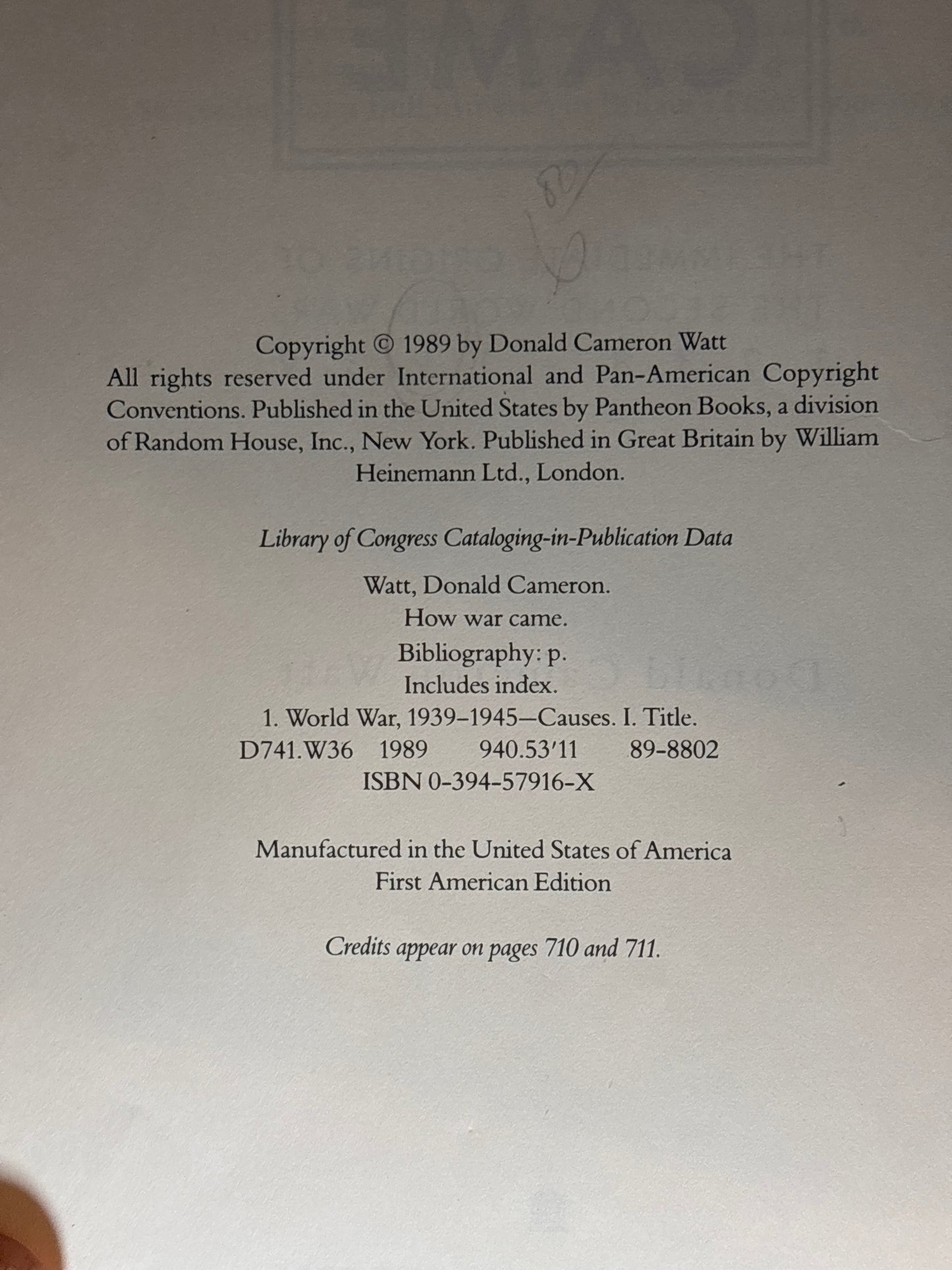
Author: Donald Cameron Watt
Condition: Good
Couldn't load pickup availability
Donald Cameron Watt's How War Came: The Immediate Origins of the Second World War offers a tightly focused diplomatic narrative of 1938–1939, tracing the people, crises and decisions that converted European tension into global conflict. Centering on the Munich crisis, the dismantling of Czechoslovakia, the German–Polish crisis and the wider manoeuvres of Germany, Britain, France, Italy and the Soviet Union, Watt examines appeasement, alliance politics, guarantees and missed opportunities for peace to show how statecraft, miscalculation and contingency produced the outbreak of war.
Share
Keywords, content and topics in this Book
Keywords, content and topics in this Book
Core bibliographic
How War Came: The Immediate Origins of the Second World War, 1938–1939
Author: Donald Cameron Watt
Pantheon Books, 1989
ISBN: 0-394-57916-X (039457916X)
Type of book
Scholarly monograph
Study of war origins
Non-fiction, academic history
Chronological focus
Interwar period
1938–1939
Immediate prelude to World War II
Crisis years before September 1939
Geographical / theater focus
European international politics
European diplomatic arena
Great Power diplomacy in Europe
Global background to a European-centered conflict
Main nations and actors (origins of war)
Germany – foreign policy and expansion
United Kingdom – appeasement and rearmament debates
France – security policy and alliance commitments
Italy – Axis diplomacy
Soviet Union (USSR) – great power diplomacy and pacts
Poland – crisis diplomacy and guarantees
Czechoslovakia – Munich and dismantling of the state
Axis and Allied great powers – prewar relations
Key themes / focus
Causes of World War II
Origins of World War II
Diplomatic history of 1930s Europe
International relations and crisis management
Appeasement policy
Alliance systems and guarantees
Decision-making of political leaders
Escalation from peace to general European war
Failure of collective security
Negotiations and missed opportunities for peace
Operations / crises and events (prewar, not wartime campaigns)
Munich crisis and Munich Agreement (1938)
Occupation of Czechoslovakia (1939)
Nazi–Soviet (Molotov–Ribbentrop) Pact context
German–Polish crisis of 1939
Ultimatums, guarantees, and declarations of war (September 1939)
Political and military leadership (as subjects of analysis)
Adolf Hitler – German decision-making and aggression
British leadership (e.g., Neville Chamberlain) – appeasement and guarantees
French political and military leadership – prewar strategy and commitments
Italian leadership – Axis alignment and policy choices
Soviet leadership – diplomacy in 1938–1939
Methodology and apparatus
Archival and primary-source based study
Comparative use of British, German, French, and other diplomatic records (as indicated by scholarly reputation and length)
Classification-style tags
World War II – Origins
World War II – Causes
Pre–World War II diplomacy
European great power politics, 1938–1939
International crisis escalation
Interwar period – end phase
History: World
Twentieth-century international history
War and diplomacy
Book Condition: Good
Book Condition: Good
You’ve reached the divisional archives. Whether you are looking for the technical blueprints of a Panzer, the gritty memoirs of an infantryman, or a bird’s-eye view of the Pacific Theater, we’ve got your intel right here. Our collection ranges from technical specs and biographies to rare photo journals and historical novels.
Before you enlist a new title into your personal library, check the Condition Report below to see how much action these volumes have seen:
New: Fresh Out of Bootcamp
Flawless and untested. This book is in pristine, new condition and ready for its first assignment.
Like New: Light Combat Experience
Almost new and in great shape. It has clearly been read before and is ready to fight again, but it shows very little wear from its time in the field.
Good: A Few Scars or Shell Shock
A reliable veteran. The book might have some bent corners or a dust cover with a few scratches, but it’s still sturdy and standing tall.
Fair: Battle-Hardened
Visible signs of a long campaign. Expect some stains, bent pages, and perhaps some minor tears on the cover. It’s seen the trenches, but the intel inside is still solid.
Poor: Survived Iwo Jima
This one has been through the meat grinder. It carries noticeable damage, heavy staining, or significant wear—but like any old soldier, it would love to be read one last time before it retires.