WW2 Bunker
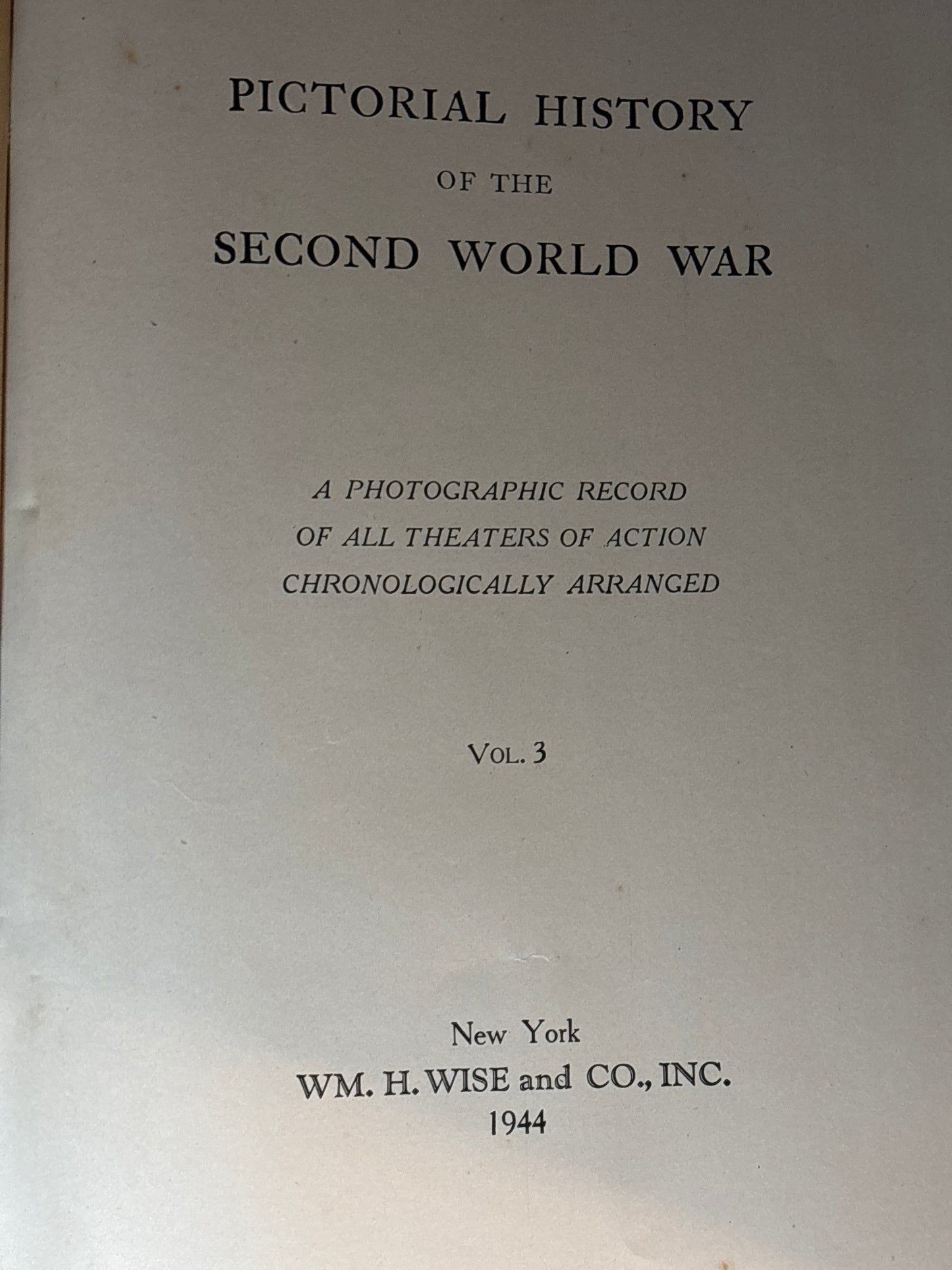
PICTORIAL HISTORY OF THE SECOND WORLD WAR, VOLUME III, FIFTH YEAR
PICTORIAL HISTORY OF THE SECOND WORLD WAR, VOLUME III, FIFTH YEAR
Author: Data not found
Condition: Good
Couldn't load pickup availability
PICTORIAL HISTORY OF THE SECOND WORLD WAR, VOLUME III, FIFTH YEAR (WM. H. WISE & CO., INC., 1944) is an image‑led chronicle of the war’s fifth year, covering September 1943–August 1944. Arranged chronologically, the volume pairs concise narrative “story” sections with dense “picture history” plates to trace decisive campaigns—from the Italian campaign (Salerno, Cassino, Anzio, entry into Rome) and the Normandy invasion to major Eastern Front offensives, Pacific island operations, the Burma–India theatre and China—while also documenting home fronts, resistance movements and high‑level conferences that shaped strategy. Its visual storytelling—action shots, aerial reconnaissance and candid home‑front scenes—gives an immediate, humanized view of battlefield intensity, logistics and civilian experience across all theaters.
Published in 1944 by WM. H. WISE & CO., INC., this volume features extensive photographic material drawn from U.S. Army Signal Corps, U.S. Navy and Marine Corps, U.S. Army Air Forces, British, Canadian, Soviet and news agencies, accompanied by detailed captions and campaign maps (Italian campaign, Pacific progress, Eastern Front, air war over Europe). The book’s dual structure of narrative and pictorial sections, comprehensive chronological scope (Sept 1943–Aug 1944), and wide representation of services, weapons and leaders make it a valuable reference for World War II enthusiasts; author information is not listed in the provided data.
Share
Keywords, content and topics in this Book
Keywords, content and topics in this Book
Type of book
Pictorial history
Photographic record
Illustrated World War II chronicle
Chronological campaign overview
Scope and structure
World War II – fifth year of the war
Coverage period: September 1943 – August 1944
All theaters of action, chronologically arranged
Combined “story” narrative sections and “picture history” sections
Main theaters of war covered
Mediterranean Theater – Italy campaign (Salerno, Volturno, Cassino, Anzio, Rome)
Western Front – Normandy landings and advance in France (including Paris)
Eastern Front – Soviet offensives (Ukraine, Crimea, Baltic States, advance to Poland and Romania)
Pacific Theater – Solomons, New Guinea, Gilberts, Marshalls, Carolines, Marianas, New Britain, Admiralties
China–Burma–India Theater (CBI) – Burma campaign, Ledo Road, Salween operations
Home Fronts – Britain (robot bomb attacks, women in services), United States (WACs, WAVES, Marines), Soviet Union, China
Atlantic and Arctic – Battle of the Atlantic, Arctic convoys, sinking of Scharnhorst
Major campaigns and operations explicitly covered
Invasion of mainland Italy (Calabria, Salerno, September 1943)
Italian campaign – Volturno line, Naples, Cassino, Anzio–Nettuno, advance and entry into Rome (June 1944)
Allied landings in Corsica and liberation of the island
Pacific island campaigns:
New Guinea: Salamaua, Lae, Finschhafen, Hollandia, Aitape, Sarmi, Wakde, Biak
Solomons: Kolombangara, Bougainville, Treasury Islands (Mono), Green Island
Gilbert Islands: Tarawa, Makin, Abemama
Marshall Islands: Kwajalein, Roi–Namur, Eniwetok, Engebi
Carolines: Truk raid
Palau–Yap–Woleai raids
Marianas: Saipan/Tinian preliminary carrier raids
Return raids on Wake Island
Eastern Front:
Italian and German retreat in southern Russia and Ukraine
Recapture of Smolensk, Bryansk, Dniepropetrovsk, Zaporozhe
Lifting of the siege of Leningrad and capture of Novgorod
Crimea campaign – Kerch, Sevastopol (May 1944)
Advances into Bukovina, Bessarabia, toward Romania (Kherson, Nikolayev, Odessa, Cernauti)
Advance to Estonian and Latvian borders, approach to East Prussia and Warsaw
Burma and India:
Stilwell’s advance in northern Burma (Hukawng and Mogaung valleys)
Myitkyina airfield attack
Wingate’s Chindit operations
Japanese offensive against Imphal and Kohima
Construction and use of the Ledo Road
China:
Battle for Changteh (Changde)
Chinese Army training and operations with U.S. support
Strategic bombing and air war:
RAF and USAAF bombing of Berlin and German industrial centers
Attacks on Ploesti and other oil/rail targets
Pre‑invasion bombing of France and the Low Countries
Battle of the Atlantic and Arctic:
Sinking of German U‑boats by escort carriers and coastal forces
Destruction of Scharnhorst off North Cape
Attacks on German E‑boats
Normandy invasion and campaign:
D‑Day landings, 6 June 1944, on Normandy beaches
American, British, and Canadian sectors (including Caen and Cherbourg drive)
Airborne operations behind the beaches
Political and strategic conferences:
Moscow conference (Hull, Eden, Molotov, Chinese ambassador)
Cairo conference (Roosevelt, Churchill, Chiang Kai‑shek)
Teheran conference (Roosevelt, Churchill, Stalin)
Principal nations and forces represented
Allies:
United States – Army, Navy, Marine Corps, Army Air Forces, Coast Guard
United Kingdom – Army, RAF, Royal Navy, commandos
Canada – Canadian Army (notably in Italy and Normandy)
Soviet Union – Red Army, Soviet Air Force, Cossack Guards, partisans
China – Nationalist Chinese Army (Chiang Kai‑shek, Stilwell’s Chinese forces)
Free French and French Army units (including Leclerc’s armored division, French troops in Italy)
Poland – Polish II Corps (at Cassino)
Yugoslav Partisans (Tito)
Other Allied and Commonwealth forces – Gurkhas, Moroccan and other French colonial troops, New Zealanders, Australians, Dutch forces
Axis:
Germany – Wehrmacht, Luftwaffe, Kriegsmarine, paratroops, SS
Italy – Royal Italian forces (pre‑armistice), Italian fleet surrender; Italian Fascists and RSI
Japan – Imperial Japanese Army and Navy, naval air forces
Axis satellites – Romania, as German ally then switching sides (context in narrative)
Branch and service focuses
Infantry combat (urban, jungle, mountain, and amphibious operations)
Armored warfare – tanks and self‑propelled artillery in Italy, Eastern Front, Normandy
Naval warfare – surface actions, carrier task forces, amphibious landings, convoys
Naval aviation and carrier warfare in the Pacific
Strategic and tactical air forces (RAF Bomber Command, USAAF 8th and 15th Air Forces, Pacific air forces, Soviet air units)
Special forces and raiders – U.S. Marine Raiders, Merrill’s Marauders, Chindits
Engineering and logistics:
Combat engineers in Italy and Pacific (improvised piers, bridge‑building, road construction in jungle)
Construction battalions (Seabees) rebuilding Pacific bases
Port clearance and salvage (Naples, Kwajalein)
Medical services – field medics, blood plasma use, evacuation and hospital ships
Women’s services – U.S. WACs, WAVES, women Marines, British women’s auxiliary service activities
Resistance and partisan warfare – Yugoslav Partisans, French Underground, Corsican resistance
Weapons, vehicles and equipment clearly depicted
Armored vehicles and artillery
U.S. 155 mm “Long Tom” gun
British 25‑pounder field gun
Self‑propelled guns (British and Canadian in Italy and Normandy)
German “Tiger” tanks (e.g., Salerno counter‑attack)
Allied tanks in Italy and Normandy (including General Sherman tanks)
Naval vessels
British battleships: Warspite, Rodney, Nelson
German battleships: Scharnhorst, Tirpitz
Italian battleships and cruisers (Italian fleet surrender to Malta)
U.S. battleships including USS Nevada
Escort carriers, destroyers, destroyer‑transports, motor gun boats (MGBs)
Landing craft: LST, LCT, LCI, LCP, LC VP, “ducks” (DUKWs), “alligators”
U‑boats and German E‑boats; one‑man submarine at Anzio
Aircraft
U.S. Army Air Forces B‑17 Flying Fortress and B‑24 Liberator heavy bombers
U.S. B‑26 Marauder medium bombers
U.S. carrier aircraft: Grumman Avenger torpedo bomber, Douglas Dauntless dive‑bomber, other carrier‑based planes
RAF heavy bombers including Lancaster (context of Berlin raids)
Fighter aircraft – Spitfire; U.S. fighters (P‑51 Mustang mentioned by type of escort; P‑47, P‑40 by role)
Japanese aircraft (bombers, fighters, dive bombers) and their destruction
German V‑1 “flying bomb” / jet‑propelled pilotless weapon (“secret weapon” drawings)
Other notable weapons and devices
White phosphorus bombs and incendiaries (New Britain airfield, strategic bombing)
Flamethrowers (e.g., Bougainville pillbox assault)
Mortars, including 4.2‑inch heavy mortars (Chinese use in Burma)
Japanese 37 mm anti‑tank gun (captured and reused by Chinese)
Mines and Teller mines; mine‑detectors and clearance parties
Rocket bombs and glider bombs used by Germans against shipping and Anzio
Key leaders and historical figures featured
Allied leaders and commanders
Franklin D. Roosevelt
Winston S. Churchill
Joseph Stalin
Chiang Kai‑shek and Madame Chiang Kai‑shek
General Dwight D. Eisenhower
General Sir Bernard L. Montgomery
General Sir Harold Alexander
Lieutenant General Mark W. Clark
Lieutenant General Sir Oliver Leese
General George S. Patton (referenced in later France narrative)
General Douglas MacArthur
Admiral Chester W. Nimitz
Admiral Raymond A. Spruance
Rear Admiral Marc A. Mitscher
Admiral Cunningham
Admiral Lord Louis Mountbatten
General Joseph W. Stilwell
General Frank Merrill
Major General Claire Chennault
General Leclerc (Philippe Leclerc de Hauteclocque)
Polish, French, Canadian and other corps commanders (e.g., General Juin)
Secretary of State Cordell Hull
Anthony Eden
V. M. Molotov
Axis and collaborationist figures
Adolf Hitler
Benito Mussolini
Marshal Badoglio
Count Galeazzo Ciano
Marshal Emilio de Bono
King Victor Emmanuel III
Crown Prince (later King) Umberto
Field Marshal Rommel
Field Marshal Tojo (as Japanese premier)
Marshal Kesselring
Marshal Tito (Yugoslav Partisans)
General Mihailovitch (Yugoslav rival resistance leader)
King Peter of Yugoslavia (context of resistance politics)
Argentine generals Pedro Ramírez and Edelmiro J. Farrell (political context)
Visual and documentary content
Extensive photographic content from multiple official and press sources:
U.S. Army Signal Corps
U.S. Navy and Marine Corps
U.S. Army Air Forces
British, Canadian, Soviet and other official photo agencies
News agencies (Acme, International News, Odhams Press, etc.)
Action photographs from all major fronts and services
Aerial reconnaissance and bombing photos (cities, ships, airfields)
Maps of key campaigns (Pacific progress, Italian campaign, Eastern Front developments, air war over Europe)
Captions providing detailed chronological and geographical context
Home fronts, civilians and social aspects
Italian civilians in battle zones; refugees returning to ruined towns
French civilians under occupation and in liberation (Rome, Normandy, Paris context)
French Underground sabotage and train wrecks
Corsican uprising and local patriots
London and English civilians under V‑weapon threat
Hunger and food queues in occupied Paris; elderly and children affected by shortages
Chinese and Burmese civilians and refugees
Native island populations in the Pacific meeting U.S. forces; rescued islanders
Prisoners of war:
Italian and German POWs in U.S. camps
Japanese POWs in Pacific bases
Allied treatment versus Axis treatment (explicit photographic contrasts)
Repatriation of American civilians via exchange ship (Gripsholm)
Resistance, occupation and collaboration
Yugoslav Partisans (Tito’s forces) in action
French Resistance / Underground sabotage of railways
Corsican resistance and island liberation
Arrests of Fascists and collaborators in Rome after liberation
German reprisals and searches for Partisans in Yugoslavia
Notable themes and subjects
Amphibious warfare and beachhead logistics (Italy, Pacific, Normandy)
Mountain and winter warfare in Italy and Eastern Front
Urban combat and street fighting (Ortona, Cassino, Sevastopol, Kiev, Rome)
Jungle warfare and “island‑hopping” strategy in the Pacific
Anti‑submarine warfare and convoy escort tactics
Strategic bombing campaigns and city destruction (Berlin and other German cities)
Civilian suffering under occupation: hunger, destruction, displacement
Allied cooperation and high‑level strategy (Cairo, Teheran, Moscow conferences)
Women in uniform and on the industrial/technical home front
Prisoners of war and adherence to Geneva Convention by Allies
Technological innovations: pilotless flying bombs (V‑1), midget submarines, road‑building in jungle, use of dogs in combat and scouting
Classification tags (for cataloging)
World War II – pictorial works
World War, 1939–1945 – Campaigns – Italy
World War, 1939–1945 – Campaigns – France – Normandy
World War, 1939–1945 – Campaigns – Eastern Front
World War, 1939–1945 – Campaigns – Pacific Area
World War, 1939–1945 – Campaigns – Burma and India
World War, 1939–1945 – Aerial operations, Allied
World War, 1939–1945 – Naval operations, Allied
World War, 1939–1945 – Underground movements – France, Yugoslavia, Corsica
World War, 1939–1945 – Personalities – Pictorial works
World War, 1939–1945 – Photographs
Allied Powers – Armed Forces – Pictorial works
Germany – History – 1939–1945 – Pictorial works
Italy – History – 1943–1945 – Pictorial works
Pacific Area – History – World War, 1939–1945 – Pictorial works
Book Condition: Good
Book Condition: Good
You’ve reached the divisional archives. Whether you are looking for the technical blueprints of a Panzer, the gritty memoirs of an infantryman, or a bird’s-eye view of the Pacific Theater, we’ve got your intel right here. Our collection ranges from technical specs and biographies to rare photo journals and historical novels.
Before you enlist a new title into your personal library, check the Condition Report below to see how much action these volumes have seen:
New: Fresh Out of Bootcamp
Flawless and untested. This book is in pristine, new condition and ready for its first assignment.
Like New: Light Combat Experience
Almost new and in great shape. It has clearly been read before and is ready to fight again, but it shows very little wear from its time in the field.
Good: A Few Scars or Shell Shock
A reliable veteran. The book might have some bent corners or a dust cover with a few scratches, but it’s still sturdy and standing tall.
Fair: Battle-Hardened
Visible signs of a long campaign. Expect some stains, bent pages, and perhaps some minor tears on the cover. It’s seen the trenches, but the intel inside is still solid.
Poor: Survived Iwo Jima
This one has been through the meat grinder. It carries noticeable damage, heavy staining, or significant wear—but like any old soldier, it would love to be read one last time before it retires.